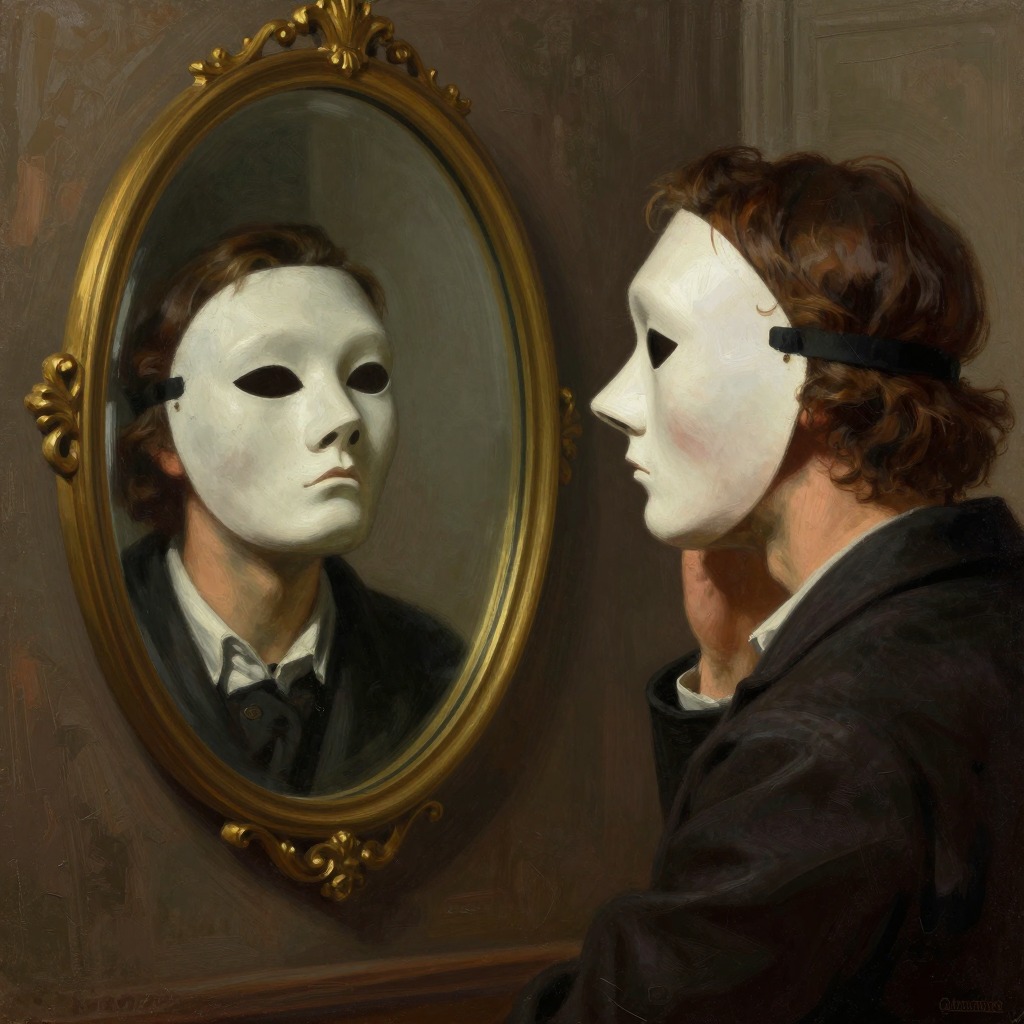
The portrait
The portrait is the central rhetorical and psychological device of Jean-Baptiste Clamence's self-invented profession as a judge-penitent. It is not a literal painting but a constructed image—a composite of vices, weaknesses, and experiences that Clamence claims to share with every listener. By presenting this portrait as his own confession, he transforms it into a mirror that forces his interlocutor to recognize the same flaws in himself, thereby reversing the direction of judgment and securing Clamence's own dominance.
Construction and Function
Clamence builds the portrait deliberately, drawing on the features he has in common with his listener: the experiences they have endured together, the failings they share. He calls this "good form, in other words, the man of the hour as he is rife in me and in others." The result is a mask, "rather like those carnival masks which are both lifelike and stylized, so that they make people say: 'Why, surely I've met him!'" The portrait is thus a universalized self-indictment, designed to be recognizable to anyone while belonging to no one in particular. Clamence's own earlier life had already been a performance of constructed roles: he had played at being efficient, intelligent, virtuous, civic-minded, shocked, indulgent, fellow-spirited, and edifying. The portrait formalizes this lifelong theatricality into a deliberate method.
The Mirror Effect
When the portrait is finished, Clamence presents it with great sorrow, declaring, "This, alas, is what I am!" He claims the prosecutor's charge is finished. But at the same moment, the portrait he holds out to his contemporaries becomes a mirror. The listener, confronted with a likeness that seems to be of Clamence yet uncannily reflects his own face, is provoked into self-judgment. This is the core of the judge-penitent's technique: Clamence accuses himself up and down, but navigates skillfully, multiplying distinctions and digressions, adapting his words to his listener and leading him to go one better. The portrait is the instrument through which Clamence extends condemnation to everyone, thinning out the weight of his own guilt by making it universal.
Theatrical Origins and the Double Face
Clamence's conception of the portrait is rooted in his lifelong theatricality. He had always been a play actor, as his imagined business card declared: "Jean-Baptiste Clamence, play actor." His earlier life was a series of performed roles, and he had even acted in plays during his military service. The portrait is the culmination of this performative existence, a mask that is both lifelike and stylized. It is the visible expression of his double face, which he described as "a charming Janus" with the motto "Don't rely on it." The portrait, like Janus, looks two ways: it is a confession of Clamence's own infamy and simultaneously an accusation of everyone else.
Narrative Role and Significance
The portrait is the key to Clamence's escape from judgment. By constructing a universal image of guilt, he ensures that no one can judge him without judging themselves. The more he accuses himself, the more right he has to judge others. The portrait is the mechanism of this reversal: it is the mask behind which he hides while exposing everyone else. It is also the mirror in which his listener sees his own condemnation. The portrait thus embodies the central paradox of the judge-penitent: a confession that is also a prosecution, a self-abasement that is also a claim to superiority. Clamence sits enthroned among his bad angels at the summit of the Dutch heaven, watching the multitude of the Last Judgment ascend toward him, and he pities without absolving, understands without forgiving, and feels at last that he is being adored.